Thursday, 2 February 2017

A publisher in a palaver

‘Our business is publishing’, Springer boasts on their homepage, a claim that’s short, direct and smashingly assertive. They’re not just saying that they have a business-like dedication to publishing: they’re also saying that the business of publishing is dedicated to them. Springer’s the boss and other publishers should budge over.
If only the rest of their writing was so sharp. Some is nonsense, like this line from their Company Information page:
The world is full of publishers. Some move forward, some go backward, and some even seem to go nowhere at all. But at Springer we move in our own unique way.
I would love to know more about how uniquely Springer moves. Do they drift up into the blue yonder? Do they scuttle sideways like corporate crabs? It is, I have to say, a brave company that admits it doesn’t go forward.

bad-dancing-580_69703a.jpg
Corporate crabs in the paper industry
But there’s a more recurring fault with their writing than silliness. You can already see the fault in the sentence above. It’s that they carpet-bomb the reader with information, giving every angle and perspective and fact that they can think of. Here’s another example from their Mission Statement. Gird your loins: it’s a slog.
Throughout the world, we provide scientific and professional communities with superior specialist information – produced by authors and colleagues across cultures in a nurtured collegial atmosphere of which we are justifiably proud. [...]
We think ahead, move fast and promote change: creative business models, inventive products, and mutually beneficial international partnerships have established us as a trusted supplier and pioneer in the information age.
I know that this is a buffet of blunders, not the least of which is that their mission statement isn’t a statement of mission. But, for the purposes of this post, let’s focus on the carpet-bombing. The first sentence alone talks about their global reach, their collegial production environment, and the superiority of their information. Why are they doing this, and does it help?
I think they’re doing it because it’s the only way they know to differentiate themselves from other publishers. Loads of publishers provide universities with specialist information, so Springer has to provide scientific and professional communities with superior specialist information. Theirs is a simplistic more-is-more philosophy.
It’s the same problem I’ve had when writing Covering Letters for job applications. They’re bad pieces of writing almost by definition. To distinguish yourself from other applicants you have to have to cram in every fact and facet of your excellence. You can either mention your Cycling Proficiency Level 2 certificate, or you can write elegantly. More often than not, I end up writing like Springer, locked in an arms race of verbiage.
Now, in military arms races countries need to compete to make more sticks and sharper sticks (or Dreadnoughts or atomic bombs). But the thing is that if you’re writing copy for websites, only sharpness helps. When Springer stuffs more adjectives and ideas into sentences, it doesn’t make them more effective. It just makes their ideas more confused. It’s like trying to make your meal more tasty by adding every spice in your rack. You just end up bewildering the flavour.
latest
A visual representation of Springer's style
And then there’s the speed at which they flick through their ideas. No reader can take in that many things at that rate. It’s like doing hyper-speed dating with concepts: you get half a second to say hi to each concept and then never see it again. Concepts need longer to ingratiate themselves with readers, to smile warmly and pat the reader’s hand.
So how might Springer go about writing more sharply? Well, fewer and slower. They could work out which are the best of their ideas, and make sure that each of those ideas gets a paragraph to itself. Everything else, however nice it might be, should get the chop. It would help to sharpen things too if, in addition to each paragraph being a unity, all the paragraphs together had a unity of focus. The focus was meant to be the company’s Mission Statement, but that got lost somewhere, and the Statement ended up just being a flea market of thoughts. In the end, they just need to follow the basic rule of writing: figure out what you want to say, and say it.

Saturday, 29 October 2016

How to write long sentences that work, ft. Gary Provost

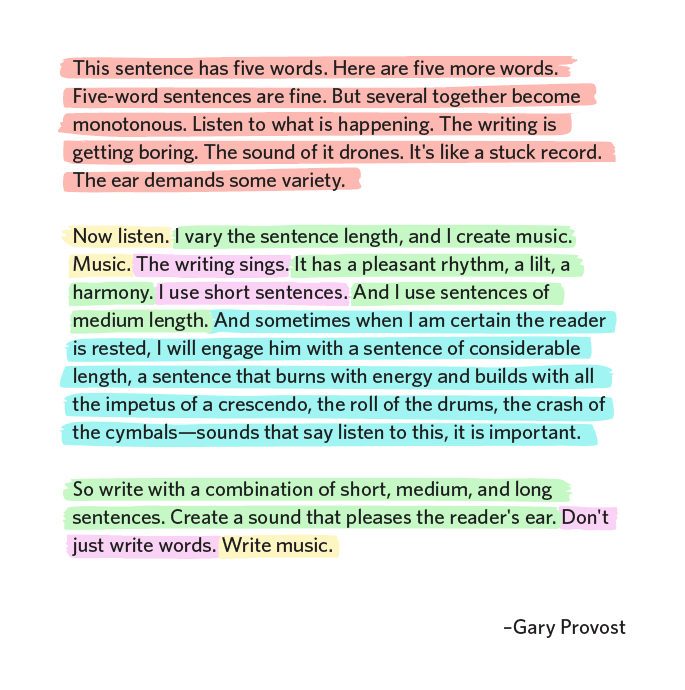
The picture below, posted regularly on Reddit, advises readers that they can make their writing sing by varying their sentence length. It’s one of Gary Provost’s 100 Ways to Improve your Writing, and it’s alright advice as far as it goes. The trouble is that Provost forgot to explain how to craft long or short sentences. Of course, it’s easy to just write a long sentence: you keep gluing ‘and’s on the end. But it’s more fiddly to craft a long sentence that doesn’t sprawl or drag or confuse your reader.
8usNRMy.png
Happily, however, Provost makes up for his lack of explanation by his example, using some excellent methods in the long blue-highlighted sentence above. And it is that long sentence we’ll be looking at because I don’t know anything about crafting short sentences. Sorry. To make it up to you, I’ll show how JFK used the very same techniques as Provost to craft a magnificent sentence for his inaugural address. So: how did Provost do it, how did JFK do it, and how can we do it?

Use summative and resumptive modifiers

The first things that makes Provost’s long sentence work are the summative and resumptive modifiers, ‘—sounds’ and ‘, a sentence’. I know they sound complex, but don’t worry, they’re not. And I know they sound dull, but try reading the sentence without them:

And sometimes when I am certain the reader is rested, I will engage him with a sentence of considerable length that burns with energy and builds with all the impetus of a crescendo, the roll of the drums, the crash of the cymbals that say listen to this, it is important.

Now the sentence lurches like a drunkard, and it’s hard to make out what the final ‘that’ refers to. This is where summative and resumptive modifiers help. Let’s define them first:
  • A resumptive modifier 1ends the previous segment with a comma or dash, 2repeats key word(s) of a previous topic, and then 3continues on as a relative clause: ‘engage him with a sentence of considerable length1, 2a sentence 3that burns with energy’.
  • Summative modifiers are much the same: they 1end the previous segment with a comma or dash, 2summarise the essence of a previous topic, and then 3continue as a relative clause: ‘the roll of the drums, the crash of the cymbals1—2sounds 3that say listen to this’.
The comma and the repetition break up long sentences, giving the reader a moment to pause and catch their breath. And because these modifiers specify the topic, they help the reader to keep track of what’s going on, to see what the ‘that’s refer to. So if you’ve got a long sentence or have lots of ‘that’s, help your readers out by introducing some summative or resumptive modifiers.

JFK did that very thing in the following soaring sentence from his inaugural address. See if you can spot the resumptive modifier.

Now the trumpet summons us again, not as a call to bear arms, though arms we need, not as a call to battle, though embattled we are, but as a call to bear the burden of a long twilight struggle, year in and year out, rejoicing in hope, patient in tribulation, a struggle against the common enemies of man: tyranny, disease, poverty, and war itself.

Without the resumptive modifier, we’d have ‘bear the burden of a long twilight struggle—year in and year out, rejoicing in hope, patient in tribulation—against the common enemies of man’. That’s baffling and unattractive, an unattractiveness which provides the greatest reason to use resumptive modifiers: they sound so elegant.

Just to show that elegant doesn’t have to mean boring or heavy, here’s Wodehouse using a resumptive modifier:

Into the face of the young man who sat on the terrace of the Hotel Magnifique at Cannes there had crept a look of furtive shame1, 2the shifty hangdog look 3which announces that an Englishman is about to talk French.
The Luck of the Bodkins, 1935

Coordinate your phrases

The second thing that Provost does is to coordinate the elements of his sentence. Coordinations instantly show the reader which parts of your sentence are parallel or equivalent to each other. You coordinate phrases by making them reflect each other’s syntax, words, cadence and so on: ‘what’s sauce for the goose | is sauce for the gander’. Here’s Provost’s sentence, structured to illuminate the coordinations:

And sometimes when I am certain the reader is rested, I will engage him with a sentence of considerable length,
a sentence that
1burns with energy and

builds with all the impetus of a crescendo,
2the roll of the drums,

the crash of the cymbals

—sounds that say listen to this, it is important.

The first coordination’s parts (‘burns …’ and ‘builds …’) are parallel: ‘burns’ and ‘builds’ alliterate, are both one syllable, and are both in the present tense; ‘with’ corresponds to ‘with’; and ‘energy’ and ‘impetus’ have a similar meaning. The second coordination’s elements match each other even more closely: only ‘roll/crash’ and ‘drums/cymbals’ change, but those words’ meanings are strongly related.

These equivalences enable us to instinctively grasp what Provost is saying. They help us feel the shape of the sentence, as the sounds and syntax show us which phrases are structurally parallel. And the parallel forms allow us to process what he’s saying faster: when we’ve understood one phrase, it’s easy to understand a similar one.

JFK’s coordinations are more complicated—he even has coordinations within coordinations—but they do the same job. They allow him to say an awful lot without confusing us. Here’s a breakdown:

Now the trumpet summons us again:
not as a call to bear arms,
though arms we need
not as a call to battle,
though embattled we are
but as a call to bear the burden of a long twilight

struggle,
year in
and year out,
rejoicing in hope,
patient in tribulation,

a struggle against the common enemies of man:
tyranny,
disease,
poverty,
and war itself.

I should say that your coordinated phrases don’t need to be short, or even very close in their form:

We need to create fixed teams for the different consumer products,
        and to ensure that our R&D stays well ahead of the opposition.

That sentence shows another thing too: like modifiers, coordination can make even dull sentences elegant and pleasant, a topic to which we now turn.

Use coordinations, and summative modifiers and resumptive modifiers to sound eloquent

Coordinations and modifiers sound eloquent because they echo other parts of the sentence. We like the sound of rhyme, rhythm and repetition. And when we use them ourselves, our words sound weighty, stately and eloquent. If you’ve ever wondered how Obama sounds so good, this is it. He does it all the time. Here’s a regular Obama sentence from his inaugural address, replete with a resumptive modifier, and four coordinations.

What is required of us now is
a new era of responsibility
—a recognition, on the part of every American that we have

duties to
ourselves,
our nation,
and the world,

duties that we
do not grudgingly accept,
but rather seize gladly,

firm in the knowledge that there is nothing
so satisfying to the spirit,
so defining of our character,
than giving our all to a difficult task.


A task such as writing exceedingly long sentences. But even Obama doesn’t use such intricate sentences all the time. The one above finished a long section, a section he wanted to end with a stirring verbal flourish. As Provost pointed out, grand sentences ‘say listen to this, it is important’. So deploy your most impressive constructions sparingly, using them to conclude or draw attention to your most impressive points.

Wednesday, 28 September 2016

Wodehouse: Stephen Fry's sacred text

Last year I bought some PG Wodehouse to ease me into the habit of reading novels. I am, unfortunately, an irredeemable heathen. Wodehouse had me in stitches, but I had to drag myself through even his works, and I’ve scarcely thumbed a novel since.
There was another reason I picked up Wodehouse, though I had scarcely any more success there either. His prose is said to be some of the best in English and, wanting to improve mine, I tried to keep an eye on how he did it. I can’t have kept a very close eye, because all I can remember deducing was that I laughed whenever he compared people to fish, as in ‘what you demand from the outside public is approval and enthusiasm – not the curling lip, the twitching nostril, and the kind of supercilious look which you see in the eye of a dead mackerel.’
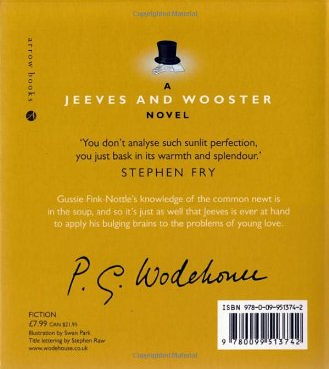
As I was conducting my halfhearted analysis, I was affronted by an odd injunction placed dead in the middle of the back cover, quoted from Stephen Fry and condemning my studies. The quotation, it turns out, is blazoned on the back of every book in Arrow’s popular republishing of Wodehouse’s works. Here it is:
It says, 'You don't analyse such sunlit perfection,
you just bask in its warmth and splendor.' You're welcome.
I couldn't understand this strange commandment. Why would Fry warn readers against analysis? He does so, I think, because of his over-the-top view of Wodehouse. I propose, hesitantly, that for him Wodehouse’s books are sacred, semi-religious texts, texts whose depths we could never plumb, whose stories we must not read incorrectly, and in which we may find enlightenment and salvation.
Psychoanalysing Stephen
The line in question originates from Fry’s introduction to What Ho!: The Best of Wodehouse, where he overviews Wodehouse’s writings and explains why he was the ‘finest and funniest writer the past century ever knew’. To explain why Wodehouse was so superb, he quotes a few nugget and offers a little analysis of Wodehouse’s techniques:
Particular to Wodehouse are the transferred epithets: ‘I lit a rather pleased cigarette’ or ‘I pronged a moody forkful of eggs and b.’ Characteristic too are the sublimely hyperbolic similes: ‘Roderick Spode. Big chap with a small moustache and the sort of eye that can open an oyster at sixty paces’ or ‘The stationmaster’s whiskers are of a Victorian bushiness and give the impression of having been grown under glass.’
Yet he finishes the section by dismissing analysis, saying,
You don’t analyse such sunlit perfection, you just bask in its warmth and splendour. Like Jeeves, Wodehouse stands alone and analysis, ultimately, is useless.
So, one should never trade basking in Wodehouse’s splendor for analysing it; and besides, analysis is fruitless anyway. Fry probably doesn’t think things are really that absolute, given that Fry he’s just analysed Wodehouse a bit himself. But he does put his case very strongly, and it’s jolly peculiar.
To me, it seems unlikely that Wodehouse’s writing is so clever that we will never understand what he did or how he did it. For starters, Fry analyses Wodehouse pretty successfully himself. Sure, he doesn’t completely inventory Wodehouse’s techniques, but then he doesn’t give himself much space to do so. I don’t see any reason why clever people with lots of time couldn't—fairly satisfyingly—explain the ingredients of Wodehouse’s writing. It’s been done with writers from Virgil to Shakespeare to Stephen King. Of course, such analyses are never complete, but their remaining mysteries are often down to the complexities of communication, rather than those of the writer. So why does Fry think that Wodehouse is beyond analysis, that he ‘stands alone’ from, say, Tolstoy or Vonnegut?
It’s peculiar too that Fry ordains the correct way to read Wodehouse. Predominantly, he says, we should be basking, an activity which is unrelated to and unaided by analysis. I say ‘predominantly’ because, as we saw earlier, Fry analyses Wodehouse himself, so analysis isn’t wholly off the cards. But surely it’s my prerogative, not his, whether I read Wodehouse to bask, to understand mid-20th c. gender roles, to be morally improved, to exercise my English or whatever else. To extend Fry’s sun metaphor: it’s good to bask in the warmth of sunlit splendour, but that doesn’t make it bad to study sunlight. Most people aren’t very interested in optical science, just as most people would not relish analysing Wodehouse. But no one can objectively prescribe that you mustn’t analyse a novel. Fry would probably never dream of telling us how to read Jack Reacher novels, so why decree how we should read Wodehouse?
csi-grissom13.jpg
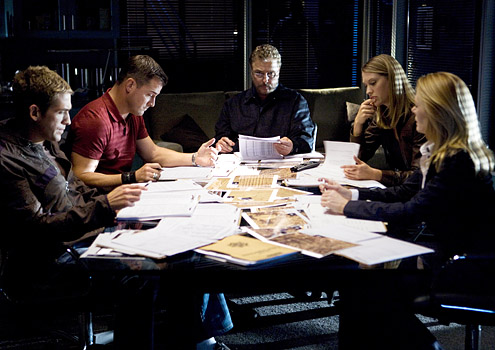
A late-night Jeeves and Wooster reading club
So here’s my wild theory to account for the special way that Fry treats Wodehouse: Wodehouse’s works are Fry’s religious texts. Like many sacred texts, they’re immeasurable, beyond analysis. As a young Christian I balked at the idea of the Bible being studied critically and in depth, for fear that it should prove to be shallow. For the Bible to be Truth it had to be immeasurable, and the idea that people might measure it worried me. For Fry, the immeasurability of Wodehouse lies partly in his linguistic wizardry, so analysing his techniques is, ultimately, useless.
As for him dictating the correct way to read Wodehouse, that too is a feature of religious texts. Muslims are, on the whole, unsympathetic to those who read their texts in a manner that has not been authorised—too critically, without enough reverence, or without acting on what they read. And now Fry, albeit amiably, is describing which reading habits are unorthodox.
My thesis feels like a stretch, even to me, but it makes good sense of the odd uniqueness that Fry accords to Woodhouse. And crucially, it corresponds with this striking paragraph from his introduction, where he describes what he found in Wodehouse’s oeuvre in essentially religious terms:
Without Wodehouse I am not sure that I would be a tenth of what I am today – whatever that may be. In my teenage years the writings of P. G. Wodehouse awoke me to the possibilities of language. His rhythms, tropes, tricks and mannerisms are deep within me. But more than that he taught me something about good nature. It is enough to be benign, to be gentle, to be funny, to be kind. He mocked himself sometimes because he knew that a great proportion of his readers came from prisons and hospitals. At the risk of being sententious, isn't it true that we are all of us, for a great part of our lives, sick or imprisoned, all of us in need of this remarkable healing spirit, this balm of hurt minds?
‘[A]woke me … taught me … healing’ sound remarkably like conversion, enlightenment and salvation. Those elements, above all, are what distinguish sacred texts. I think they’re the crucial reason that Fry decries analysis and why he needs Wodehouse’s writings to be depthless. Wodehouse offers salvation and truth, but those things may not be certain if his texts are so shallow that they can be analysed; and they may not be obtained if the texts are read wrongly.
Shoot straighter
So we’ve seen that Fry’s statement from the back of Arrow’s books doesn’t make much sense. Rather, it and others from his introduction seem to be religious statements about a holy text. Arrow’s choice of the quotation now looks really odd—they’ve picked a quotation which is rooted in extremely idiosyncratic views, views which they probably don’t hold themselves. Granted, it is possible that Fry was being hyperbolic in his elevation of Wodehouse. But then Fry didn’t give any hint that he’s being hyperbolic. And even if he had, that context was lost when the quotation was stuck on the back Arrow’s books.

Often people say odd things simply because they’re mistaken. But sometimes, as in this case, their unusual comments are part of an unusual system. Because we can’t always tell what’s motivated an odd comment, we naturally give people the benefit of the doubt. However, if you’re going to stick the comment on the back of thousands of books, you should probe a little deeper. Things aren’t always what they seem.