Wednesday, 28 September 2016

Wodehouse: Stephen Fry's sacred text

Last year I bought some PG Wodehouse to ease me into the habit of reading novels. I am, unfortunately, an irredeemable heathen. Wodehouse had me in stitches, but I had to drag myself through even his works, and I’ve scarcely thumbed a novel since.
There was another reason I picked up Wodehouse, though I had scarcely any more success there either. His prose is said to be some of the best in English and, wanting to improve mine, I tried to keep an eye on how he did it. I can’t have kept a very close eye, because all I can remember deducing was that I laughed whenever he compared people to fish, as in ‘what you demand from the outside public is approval and enthusiasm – not the curling lip, the twitching nostril, and the kind of supercilious look which you see in the eye of a dead mackerel.’
As I was conducting my halfhearted analysis, I was affronted by an odd injunction placed dead in the middle of the back cover, quoted from Stephen Fry and condemning my studies. The quotation, it turns out, is blazoned on the back of every book in Arrow’s popular republishing of Wodehouse’s works. Here it is:
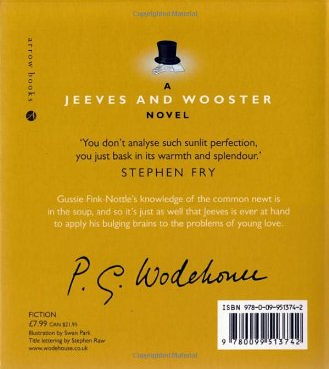
It says, 'You don't analyse such sunlit perfection,
you just bask in its warmth and splendor.' You're welcome.
I couldn't understand this strange commandment. Why would Fry warn readers against analysis? He does so, I think, because of his over-the-top view of Wodehouse. I propose, hesitantly, that for him Wodehouse’s books are sacred, semi-religious texts, texts whose depths we could never plumb, whose stories we must not read incorrectly, and in which we may find enlightenment and salvation.
Psychoanalysing Stephen
The line in question originates from Fry’s introduction to What Ho!: The Best of Wodehouse, where he overviews Wodehouse’s writings and explains why he was the ‘finest and funniest writer the past century ever knew’. To explain why Wodehouse was so superb, he quotes a few nugget and offers a little analysis of Wodehouse’s techniques:
Particular to Wodehouse are the transferred epithets: ‘I lit a rather pleased cigarette’ or ‘I pronged a moody forkful of eggs and b.’ Characteristic too are the sublimely hyperbolic similes: ‘Roderick Spode. Big chap with a small moustache and the sort of eye that can open an oyster at sixty paces’ or ‘The stationmaster’s whiskers are of a Victorian bushiness and give the impression of having been grown under glass.’
Yet he finishes the section by dismissing analysis, saying,
You don’t analyse such sunlit perfection, you just bask in its warmth and splendour. Like Jeeves, Wodehouse stands alone and analysis, ultimately, is useless.
So, one should never trade basking in Wodehouse’s splendor for analysing it; and besides, analysis is fruitless anyway. Fry probably doesn’t think things are really that absolute, given that Fry he’s just analysed Wodehouse a bit himself. But he does put his case very strongly, and it’s jolly peculiar.
To me, it seems unlikely that Wodehouse’s writing is so clever that we will never understand what he did or how he did it. For starters, Fry analyses Wodehouse pretty successfully himself. Sure, he doesn’t completely inventory Wodehouse’s techniques, but then he doesn’t give himself much space to do so. I don’t see any reason why clever people with lots of time couldn't—fairly satisfyingly—explain the ingredients of Wodehouse’s writing. It’s been done with writers from Virgil to Shakespeare to Stephen King. Of course, such analyses are never complete, but their remaining mysteries are often down to the complexities of communication, rather than those of the writer. So why does Fry think that Wodehouse is beyond analysis, that he ‘stands alone’ from, say, Tolstoy or Vonnegut?
It’s peculiar too that Fry ordains the correct way to read Wodehouse. Predominantly, he says, we should be basking, an activity which is unrelated to and unaided by analysis. I say ‘predominantly’ because, as we saw earlier, Fry analyses Wodehouse himself, so analysis isn’t wholly off the cards. But surely it’s my prerogative, not his, whether I read Wodehouse to bask, to understand mid-20th c. gender roles, to be morally improved, to exercise my English or whatever else. To extend Fry’s sun metaphor: it’s good to bask in the warmth of sunlit splendour, but that doesn’t make it bad to study sunlight. Most people aren’t very interested in optical science, just as most people would not relish analysing Wodehouse. But no one can objectively prescribe that you mustn’t analyse a novel. Fry would probably never dream of telling us how to read Jack Reacher novels, so why decree how we should read Wodehouse?
csi-grissom13.jpg
A late-night Jeeves and Wooster reading club
So here’s my wild theory to account for the special way that Fry treats Wodehouse: Wodehouse’s works are Fry’s religious texts. Like many sacred texts, they’re immeasurable, beyond analysis. As a young Christian I balked at the idea of the Bible being studied critically and in depth, for fear that it should prove to be shallow. For the Bible to be Truth it had to be immeasurable, and the idea that people might measure it worried me. For Fry, the immeasurability of Wodehouse lies partly in his linguistic wizardry, so analysing his techniques is, ultimately, useless.
As for him dictating the correct way to read Wodehouse, that too is a feature of religious texts. Muslims are, on the whole, unsympathetic to those who read their texts in a manner that has not been authorised—too critically, without enough reverence, or without acting on what they read. And now Fry, albeit amiably, is describing which reading habits are unorthodox.
My thesis feels like a stretch, even to me, but it makes good sense of the odd uniqueness that Fry accords to Woodhouse. And crucially, it corresponds with this striking paragraph from his introduction, where he describes what he found in Wodehouse’s oeuvre in essentially religious terms:
Without Wodehouse I am not sure that I would be a tenth of what I am today – whatever that may be. In my teenage years the writings of P. G. Wodehouse awoke me to the possibilities of language. His rhythms, tropes, tricks and mannerisms are deep within me. But more than that he taught me something about good nature. It is enough to be benign, to be gentle, to be funny, to be kind. He mocked himself sometimes because he knew that a great proportion of his readers came from prisons and hospitals. At the risk of being sententious, isn't it true that we are all of us, for a great part of our lives, sick or imprisoned, all of us in need of this remarkable healing spirit, this balm of hurt minds?
‘[A]woke me … taught me … healing’ sound remarkably like conversion, enlightenment and salvation. Those elements, above all, are what distinguish sacred texts. I think they’re the crucial reason that Fry decries analysis and why he needs Wodehouse’s writings to be depthless. Wodehouse offers salvation and truth, but those things may not be certain if his texts are so shallow that they can be analysed; and they may not be obtained if the texts are read wrongly.
Shoot straighter
So we’ve seen that Fry’s statement from the back of Arrow’s books doesn’t make much sense. Rather, it and others from his introduction seem to be religious statements about a holy text. Arrow’s choice of the quotation now looks really odd—they’ve picked a quotation which is rooted in extremely idiosyncratic views, views which they probably don’t hold themselves. Granted, it is possible that Fry was being hyperbolic in his elevation of Wodehouse. But then Fry didn’t give any hint that he’s being hyperbolic. And even if he had, that context was lost when the quotation was stuck on the back Arrow’s books.

Often people say odd things simply because they’re mistaken. But sometimes, as in this case, their unusual comments are part of an unusual system. Because we can’t always tell what’s motivated an odd comment, we naturally give people the benefit of the doubt. However, if you’re going to stick the comment on the back of thousands of books, you should probe a little deeper. Things aren’t always what they seem.

Wednesday, 6 July 2016

Simplicity and clarity and The Elements of Eloquence

I recently finished Mark Forsyth’s book The Elements of Eloquence. It’s about rhetorical 
devices, and it’s brilliant. Forsyth explains that we often use these rhetorical devices but 
we use them haphazardly. We just happen to say something beautiful, and we don’t 
know how we did it. We are like blindfolded cooks throwing anything into the pot 
and occasionally, just occasionally, producing a delicious meal.
Forsyth’s aim is to explain the figures of rhetoric to his readers, so that they can speak and 
scribble with ‘a big recipe book and [their] eyes wide open.’ It’s a great idea, and he does a 
great job. 
There is one paragraph at the end of the book, however, where he gets it wrong for his 
readers. He writes:
Above all, I hope I have dispelled the bleak and imbecilic idea that the aim of writing 
is to express yourself clearly in plain, simple English using as few words as possible. 
This is a fiction, a fallacy, a fantasy and a falsehood. To write for mere utility is as 
foolish as to dress for mere utility. Mountaineers do it, and climb Everest in clothes 
that would have you laughed out of the gutter. I suspect that they also communicate 
quickly and efficiently, poor things. But for the rest of us, not threatened by death 
and yetis, clothes and language can be things of beauty.
This is Mark Forsyth all over: hilarious, eccentric, and buoyantly eloquent. Yet it’s also 
misleading. The aim of writing may not be ‘to express yourself clearly in plain, simple 
English using as few words as possible’, but for the most part it’s jolly close. 
Take simplicity. Being able to express yourself simply is a foundation of being able to write 
well. Those who can’t write simply are like jazz musicians who haven’t learnt their scales, 
or like boxers who can’t do elementary footwork. No matter how skilled they may be in other 
ways, their performance will always be clumsy. So too with writing plainly and efficiently: 
the better you can do it, the better you understand your argument and your language. A 
writer who can’t is enormously disadvantaged. 
Of course, jazz scales on their own are as dull for an audience as Spot the Dog sentences are 
for a reader. But if you can’t do the basics, you don’t yet know your craft.
And there are libraries filled with craftless, artless books. I think of the jumbled essays on 
public policy I’ve read recently and the hours I wasted deciphering overly-complex articles at 
university. You know the ones I’m talking about because you had to read them too. Such 
works exasperate their readers, frustrating their learning and squandering their interest. 
Adding figures of speech to these pieces would be as helpful as spreading icing on a turnip. 
It’s not as if simple English is unenjoyable either. I don’t mean clinical or stuffy English, but 
straightforward English that uses the language of everyday speech. Some of the most 
enjoyable English I’ve ever read is written that way. Simplicity has its own elegance.

Which brings us back to Martin Forsyth. Read his paragraph again, and you’ll notice that his 
– genuinely delightful – writing exhibits the very virtues he downplays. He may be eloquent, 
but his writing has a conversational simplicity. He’s also pretty efficient, saying in a few 
lively sentences what a worse writer might’ve stretched to paragraphs and pages. And he’s 
unwaveringly clear. He uses no double negatives, only one subordinate clause, and short 
sentences. He may not exactly ‘express [himself] clearly in plain, simple English using as few 
words as possible’, but he nearly does, and it makes him a pleasure to read.
Yet most of us are not nearly so able, and he’s doing us no favours by being so unenthusiastic 
about clarity and simplicity. To go back to boxing, Mark Forsyth’s like someone who’s boxed 
until boxing’s in his bones, who bounds effortlessly round the ring and whose punches are 
swift as sunlight. He could perform basic footwork or throw textbook punches, only he’s 
moved quite beyond that. But he doesn’t help us us amateurs when he gives so little credit to 
the fundamentals. It’s enough to put you off your footwork drills.
Ultimately, I suspect, his paragraph won’t do much harm. Readers will probably be 
influenced less by Mark’s argument than by his infectious style. His style is lithe and lucid, 
and readers will be doing very well if they copy him. 
Nevertheless, his paragraph hasn’t done as much good as it could have. I think he should’ve 
said that simplicity and brevity and clarity are good, but gooder still is writing that’s clear 
and beautiful. A more accurate (but less funny) analogy than his might be this. Winter gives 
trees an austere elegance, but spring’s leaves and summer’s fruits give trees beauty. Trees 
never stop being trees, just as good writing is always influenced—if not pervaded—by clarity
and co. It’s just that in spring, trees come to life.


Monday, 4 July 2016

Race and Faith: The Deafening Silence, Trevor Phillips [Civitas, 2016]

Summary

1. What makes minorities succeed or fail, and why haven’t anti-discrimination laws helped them much?

British governments have tried to improve the outcomes of minorities by legislating against discrimination.

These legal interventions have not helped much because the outcomes of minorities are determined less by prejudice or racism than they are by the minorities’ own ethonocultures. A minority’s ethnoculture shapes its members’ ambitions, values and behaviour. Such traits in turn influence how much money a minority’s members will make, the chance they’ll commit a crime, how well they will do in school, their views on sexuality etc. Such differences often persist over many generations. These differences have been objectively demonstrated by Big Data.

In other words, it’s not all about white racism and oppression. It’s not even mostly about that.

2. How can we integrate minorities better, and what happens if we don’t?

Britain used to integrate new migrants passively, through organic integration. It accommodated migrants and their traditions, and expected that over time migrants would adopt British values and behaviour. But this method is no longer feasible. It’s too slow and the pressures are too great. Today’s minorities are big and superdiverse, and many have values vastly different to Britain’s. Unless we take a more muscular approach to integration, we will face enormous social difficulties and perhaps catastrophe.

Despite the importance of race and integration, no one—particularly the media and politicians—likes to talk publicly about these issues.

Many people, however, are privately worried. This points to one potential social difficulty: that an alarmed majority may give in to its fears of minorities, lashing out against them.

Another potential social difficulty is the pernicious culture of offense. People are becoming more offended about more things, a touchiness which is increasing social friction and stirring dangerous demands that freedom of expression be curtailed.

We need to implement active integration, creating an environment that more strongly incentivises and encourages minorities to integrate. Three things would help. First, organisations like workplaces and schools should be required to demonstrate that they’re promoting integration. Second, these organisations should have to publish data related to integration. This measure would enable greater scrutiny, openness, and analysis of the effects of ethnocultures. Finally, freedom of expression should be allowed in all cases, except when the speaker promotes violence or lawbreaking.

And we need to act now.


Verdict on the essay’s clarity

The essay leaves too much work to the reader. On the one hand, its sentences and paragraphs are clear. Readers will grasp the ideas of each page without much effort. On the other hand, the essay’s structure is jumbled and ill-explained. Readers will have to labour to synthesise the essay’s ideas into something ordered and cohesive. This is chiefly for three reasons.

1. The essay’s major topics have been sliced up and scattered throughout the essay. The first point in the above summary, for instance, is split across at least 7 different sections.

2. The writer scarcely guides the reader through this disarray. So it’s up to the reader to work out which of the essay’s snatches of information are connected, and to order that information into a cohesive argument.

3. When the writer does try to guide the reader, he doesn’t do so helpfully. For one, the essay’s headings don’t divide up the essay very usefully. Also, when the writer explains the essay’s structure to the reader, he explains it inaccurately. The introduction claims that the ‘essay makes the case for the defence of [the] values [of liberty and equality]; and for an entirely new approach to the downsides of diversity: active integration’. While the essay does explain active integration, it has almost nothing to say about British values and makes no case for their defence. And the essay has a lot to say about topics that the introduction doesn’t even mention.